
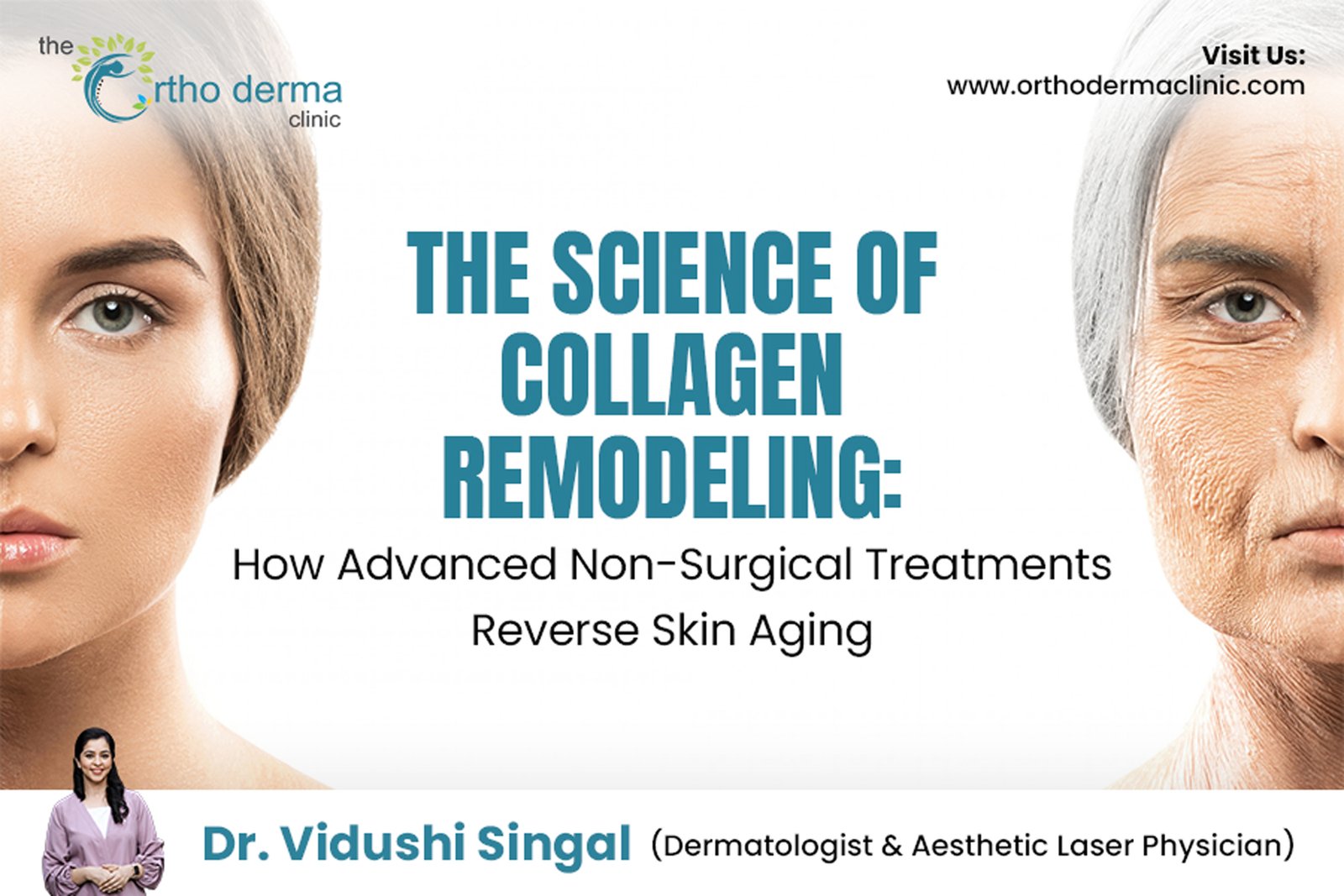
‘Can I really turn back the clock without surgery?’ The answer, in 2025, is a resounding yes — but the science behind it is far more fascinating than most people realize.
Skin aging is not a mystery. It is a predictable, well-understood biological process — driven in large part by the progressive loss and degradation of collagen, the scaffolding protein that gives your skin its firmness, elasticity, and youthful plumpness. By the time most patients walk into our clinic, they have already lost significant collagen density, and the visible signs — wrinkles, laxity, dullness — are telling that story.
What has transformed the field of aesthetic dermatology over the past decade is not cosmetics — it is biomedical engineering. We now have a sophisticated toolkit of energy-based and biostimulatory devices that can trigger the skin’s own repair machinery to rebuild collagen from within.
At Orthoderma Clinic, we use these technologies precisely and individually to help patients achieve genuinely visible rejuvenation — with no surgery, no general anaesthesia, and minimal downtime.
This article takes you deep into science. We will explore what collagen is, why it degrades, how modern treatments stimulate its remodeling, and what you can realistically expect from today’s best non-surgical approaches.
What Is Collagen and Why Does It Matter So Much?
Collagen is the most abundant protein in the human body, accounting for approximately 30% of total protein mass. In the skin alone, it constitutes nearly 70–80% of the dry weight of the dermis — the deep structural layer beneath the surface. There are over 28 types of collagen identified in humans, but Types I and III are the workhorses of skin integrity:
Type I Collagen — the most abundant. Forms thick, tightly packed fibres that provide tensile strength, firmness, and resistance to stretching. This is the collagen that makes young skin feel taut and resilient.
Type III Collagen — thinner, more flexible fibres that impart elasticity. More prevalent in younger skin; decreases with age. Think of it as the “bounce-back” collagen.
Type IV Collagen — forms the basement membrane, anchoring the epidermis to the dermis. Its degradation accelerates skin thinning with age.
Collagen fibres are synthesised by specialised cells called fibroblasts, which reside in the dermis. These fibroblasts respond to mechanical stress, growth factor signals, and controlled injury by ramping up collagen production. Understanding this is the foundation of every effective anti-aging treatment we use.
“Think of your dermis as a luxury mattress. Collagen is the coil spring system. When you are young, those springs are dense, taut, and perfectly arranged. Over time, the springs loosen, break, and thin out. Modern aesthetic medicine’s goal is not just to add padding on top — it is to restore the spring system itself.”
— Dr. Vidushi Singal, Orthoderma Clinic
The Biology of Skin Aging: Why Collagen Degrades
Collagen loss is not a single event — it is the cumulative result of several overlapping biological processes. Understanding these mechanisms is critical because different treatments target different parts of this cascade.
1. Intrinsic (Chronological) Aging
From approximately age 25, fibroblast activity naturally begins to slow. Collagen synthesis decreases by roughly 1–1.5% per year. Simultaneously, collagen cross-linking becomes irregular, forming disorganised fibres that lack the architectural precision of youthful collagen. The result is progressively thinner, less firm skin that recovers more slowly from deformation.
2. Photoaging — UV-Induced Damage
Ultraviolet radiation is the single greatest external accelerant of skin aging, accounting for an estimated 80–90% of visible facial aging. UV-A and UV-B rays penetrate the dermis and trigger the release of matrix metalloproteinases (MMPs) — enzymes that actively digest collagen fibres. UV radiation also generates free radicals that damage fibroblast DNA, impairing their ability to produce new collagen. The end result is a chaotic dermis populated by fragmented, disorganised collagen — what dermatologists describe as “elastosis.”
3. Hormonal Influences
Oestrogen plays a significant role in maintaining collagen density. Studies have shown that women lose approximately 30% of dermal collagen in the first 5 years following menopause, with collagen content continuing to decline by about 2% per year thereafter. This is why skin aging can feel sudden and dramatic for many women in their 50s.
4. Glycation
Sugar molecules in the bloodstream bind to collagen fibres in a process called glycation, forming advanced glycation end-products (AGEs). These cross-link collagen fibres abnormally, making them stiff, brittle, and yellow-tinged — contributing to both the texture changes and the dullness characteristic of aging skin.
5. Lifestyle Accelerants
Smoking, chronic psychological stress, pollution, poor diet, and sleep deprivation all accelerate collagen degradation through various mechanisms — increased MMP activity, free radical damage, and impaired growth factor signalling. These are modifiable risk factors, and addressing them is the foundation of any effective anti-aging strategy.
The Science of Collagen Remodeling: How Treatments Work
All effective collagen-stimulating treatments share a common biological mechanism — they induce a controlled, reparative injury response in the dermis. When the body detects tissue stress or micro-damage, it activates a precisely orchestrated wound-healing cascade:
1 Inflammatory Phase (Days 1–5)
Growth factors including TGF-β (Transforming Growth Factor Beta), PDGF (Platelet-Derived Growth Factor), and EGF (Epidermal Growth Factor) are released. These act as chemical signals, recruiting fibroblasts to the site of injury.
2 Proliferative Phase (Weeks 1–6)
Activated fibroblasts (called myofibroblasts) dramatically upregulate Type I and Type III collagen synthesis. New collagen fibres begin laying down in an organised scaffold.
3 Remodeling Phase (Months 1–12)
The newly synthesised collagen undergoes progressive cross-linking and organisation. Collagen fibres thicken, align properly, and increase in density — this is the phase where patients see the most dramatic clinical results. MMPs selectively break down disorganised old collagen while new structured collagen replaces it.
The art and science of aesthetic medicine lies in delivering just enough controlled stimulus to trigger this cascade vigorously — without causing collateral damage. Too little energy, and the response is sub-therapeutic. Too much, and scarring can occur. This is why expertise, calibrated devices, and individualised protocols matter enormously.
Advanced Non-Surgical Treatments That Remodel Collagen
At Orthoderma Clinic, we offer the following evidence-backed modalities for collagen remodeling. Each uses a different mechanism to trigger the same fundamental biological cascade:
HIFU — High-Intensity Focused Ultrasound
HIFU delivers precise focal points of ultrasound energy to the deep dermis (2–4.5mm) and the SMAS (superficial musculoaponeurotic system) — the same anatomical layer addressed in a surgical facelift. At the focal point, temperatures reach 60–70°C, causing immediate collagen denaturation and contraction, followed by a robust new collagen synthesis response over 3–6 months. The skin surface remains completely intact. HIFU is currently the only non-invasive treatment that reaches the SMAS layer.
SKIN TIGHTENING · LIFTING · JAWLINE
Radiofrequency (RF) Microneedling
RF microneedling combines two powerful collagen stimulators: precise micro-injuries from insulated needles and thermal energy delivered by RF current at the needle tips. This creates controlled zones of dermal heating (typically 60–70°C) at exact depths, triggering intense fibroblast activation. The technique is particularly effective for skin laxity, enlarged pores, acne scars, and striae (stretch marks). Because the needle penetration is controllable, RF microneedling can be customised for different anatomical zones with exceptional precision.
PORES · LAXITY · SCARRING
Fractional Laser Resurfacing
Fractional lasers (both ablative CO₂ and non-ablative types like 1550nm Erbium) create thousands of microscopic thermal injury columns — called Microscopic Treatment Zones (MTZs) — within the skin, leaving intervening tissue intact for rapid healing. Within each MTZ, old collagen is thermally coagulated and subsequently replaced by new, organised collagen during the remodeling phase. The surrounding intact skin accelerates recovery. Results include improved texture, reduced pigmentation, tightened pores, and significantly smoother skin quality.
TEXTURE · PIGMENTATION · RESURFACING
Profhilo — Bioremodeling Injectable
Profhilo is not a filler — it is a unique highly purified hyaluronic acid formulation that bio-remodels the skin from within. Unlike conventional fillers, it diffuses through the dermis, hydrating extensively and stimulating four types of collagen (I, III, IV, and VII) as well as elastin. It acts on fibroblasts, keratinocytes, and adipocytes simultaneously. Clinical studies show measurable increases in dermal density within 8 weeks. It is particularly effective for skin laxity on the face, neck, décolletage, and hands — areas where volume addition would be inappropriate.
HYDRATION · BIO-REMODELING · ELASTIN
PRP — Platelet-Rich Plasma
PRP uses the patient’s own blood, centrifuged to concentrate platelets to 3–5× normal levels. When injected or micro-needled into the skin, the platelets release a cascade of growth factors — PDGF, TGF-β, VEGF, and IGF-1 — that directly stimulate fibroblast proliferation and new collagen synthesis. PRP is especially effective when combined with microneedling or fractional laser, significantly amplifying results. Its autologous nature means near-zero risk of allergic reaction, making it an excellent choice for sensitive skin types.
GROWTH FACTORS · AUTOLOGOUS · HAIR RESTORATION
Comparing Treatments: Which Is Right for You?
Selecting the right collagen-remodeling treatment depends on multiple factors: degree of skin laxity, depth of concern, skin type, downtime tolerance, and treatment goals. The following overview provides a general guide:
| Treatment | Best For | Depth of Action | Downtime | Results Timeline |
| HIFU | Moderate-to-significant laxity, jowls, brow lift | SMAS + deep dermis | Minimal | 3–6 months |
| RF Microneedling | Pores, texture, acne scars, skin tightening | Mid-to-deep dermis | 2–5 days | 4–8 weeks |
| Fractional Laser | Pigmentation, deep wrinkles, resurfacing | Epidermis + dermis | 3–7 days | 4–12 weeks |
| Profhilo | Skin laxity, crepiness, neck & hands | Dermal diffusion | None | 4–8 weeks |
| PRP | Skin quality, hair loss, post-laser healing | Superficial to mid dermis | Minimal | 4–8 weeks |
The Power of Combination Protocols
In clinical practice, the most impressive results come not from a single treatment in isolation, but from intelligently stacked combination protocols. This approach targets different depths of the skin simultaneously and exploits synergistic biological responses.
At Orthoderma Clinic, a common example is our Lift & Renew Protocol, which combines HIFU for deep structural lifting, RF microneedling for mid-dermal remodeling, and Profhilo or PRP injections to optimise skin quality and hydration. Spaced appropriately, these treatments amplify each other’s collagen-stimulating effects, producing results that neither could achieve alone.
Combination therapy also allows for dosing flexibility. Each individual treatment can be delivered at a moderate intensity, reducing downtime and side-effect risk, while the cumulative biological stimulus remains high. This is a significant advantage over pushing any single modality to its maximum — which raises risk without proportionate benefit.
What to Expect: Realistic Outcomes and the Importance of Patience
One of the most important conversations we have with patients at Orthoderma Clinic is about timeline expectations. Collagen remodeling is a biological process that cannot be rushed. Unlike injectable fillers that produce immediate volume, collagen-stimulating treatments require your body’s repair machinery to do its work. This takes time — but the results are qualitatively different and far more natural.
Weeks 1–4: Initial inflammatory response. The skin may appear slightly flushed or feel tighter. Some patients see early improvements in texture and hydration (particularly with Profhilo and PRP).
Months 1–3: The proliferative phase peaks. New collagen fibres are being actively laid down. Many patients report progressive firming, improved skin quality, and reduction in fine lines.
Months 3–6: The remodeling phase matures. This is when the most dramatic lifting and tightening effects become visible — particularly with HIFU and RF microneedling. Skin takes on a smoother, denser, more youthful quality.
6–12 months: Results continue to refine. Most patients are advised on a maintenance protocol (typically one session every 6–12 months) to sustain and build on results over time.
Results are influenced significantly by baseline skin health, age, lifestyle, sun protection compliance, and nutritional status. A comprehensive anti-aging strategy that addresses these foundations alongside clinical treatments consistently delivers superior outcomes.
Supporting Collagen From the Inside: Complementary Strategies
Aesthetic treatments work best when supported by a comprehensive lifestyle and skincare foundation. At Orthoderma Clinic, we always pair in-clinic treatments with personalised at-home protocols that include:
Broad-spectrum SPF 50+ — daily sunscreen is the single most evidence-based intervention to prevent further collagen degradation. No treatment produces lasting results without sun protection.
Topical Retinoids (Tretinoin / Retinol) — the most studied topical agents for collagen synthesis. Retinoids upregulate fibroblast activity and counteract MMP-mediated collagen breakdown.
Vitamin C Serum (L-Ascorbic Acid) — an essential cofactor in collagen synthesis and a potent antioxidant. Vitamin C stabilises the collagen triple helix and neutralises UV-generated free radicals.
Peptide-based formulations — signal peptides mimic collagen breakdown products, stimulating fibroblasts to upregulate production. Particularly useful in the post-treatment remodeling phase.
Collagen-supporting nutrition — adequate dietary protein, Vitamin C, zinc, copper, and antioxidant-rich foods support fibroblast function. Minimising high-glycaemic foods reduces glycation-mediated collagen damage.
Sleep and stress management — growth hormone is predominantly secreted during deep sleep and directly stimulates fibroblast activity. Chronic cortisol elevation suppresses collagen synthesis.
Frequently Asked Questions
How many sessions will I need to see results?
It depends on the treatment and the degree of concern. HIFU typically requires 1–2 sessions per year. RF microneedling is usually performed in a series of 3–4 sessions, 4–6 weeks apart. Profhilo requires 2 sessions, 4 weeks apart, followed by maintenance. PRP and polynucleotides are typically performed monthly for 3–4 sessions initially. During your consultation, Dr. Vidushi Singal will assess your skin and design a protocol specific to your goals.
Are these treatments safe for Indian skin tones?
Absolutely. Fitzpatrick skin types IV–VI (common in the Indian population) require specific consideration when selecting treatment parameters, particularly for laser and light-based modalities, to avoid post-inflammatory hyperpigmentation. At Orthoderma Clinic, we have extensive experience treating Indian skin tones safely. HIFU, RF microneedling, Profhilo, PRP, and polynucleotides all have excellent safety profiles across all skin tones when performed by an experienced dermatologist with appropriate protocols.
Is collagen remodeling painful?
Most treatments are well-tolerated with topical anaesthetic cream applied 30–45 minutes prior to the procedure. HIFU can feel like brief flickers of warmth or mild tingling. RF microneedling may produce a sensation of heat and pressure. Injectable treatments like PRP and Profhilo involve minimal discomfort. We prioritise patient comfort at every stage of the procedure and adjust parameters accordingly.
Can I combine these treatments with Botox or fillers?
Yes, and this is often the ideal approach. Collagen-stimulating treatments address skin quality, texture, and laxity — the deep structural and biological layer of aging. Botulinum toxin addresses dynamic expression lines, and hyaluronic acid fillers restore volume loss. These modalities are complementary, targeting different aspects of facial aging. Most combination protocols are spaced appropriately to allow optimal healing between sessions.
What age should I start collagen remodeling treatments?
Prevention is more effective than reversal. Many patients in their late 20s and 30s benefit from early collagen maintenance treatments — particularly Profhilo, PRP, and light-energy facials — to slow the natural decline before laxity becomes significant. Patients in their 40s and beyond typically benefit from more intensive protocols combining HIFU, RF microneedling, and biostimulators. There is no single “right” age — the appropriate starting point is based on your current skin condition and goals, assessed during a personalised consultation.
Ready to Rebuild Your Skin from Within?
At Orthoderma Clinic, Dr. Vidushi Singal offers personalised consultations to assess your skin’s specific collagen profile and design a treatment strategy tailored to your biology, lifestyle, and goals — not a one-size-fits-all protocol.
Conclusion: Aging Is Inevitable — Visible Aging Is Not
The loss of collagen with age is biologically inevitable. But the clinical consequences of that loss — sagging, wrinkling, thinning, dullness — are now, more than ever, modifiable. Advanced non-surgical treatments give us the ability to engage the skin’s own regenerative biology, producing results that were unimaginable even fifteen years ago.
The key is understanding the science, matching the right treatment to the right concern, and approaching rejuvenation as a long-term strategy rather than a single event. At Orthoderma Clinic, that is precisely our philosophy — combining rigorous clinical science with individualised, thoughtful care.
If you are ready to understand what your skin specifically needs — and what is realistically possible — we would love to see you for a consultation with Dr. Vidushi Singal.