
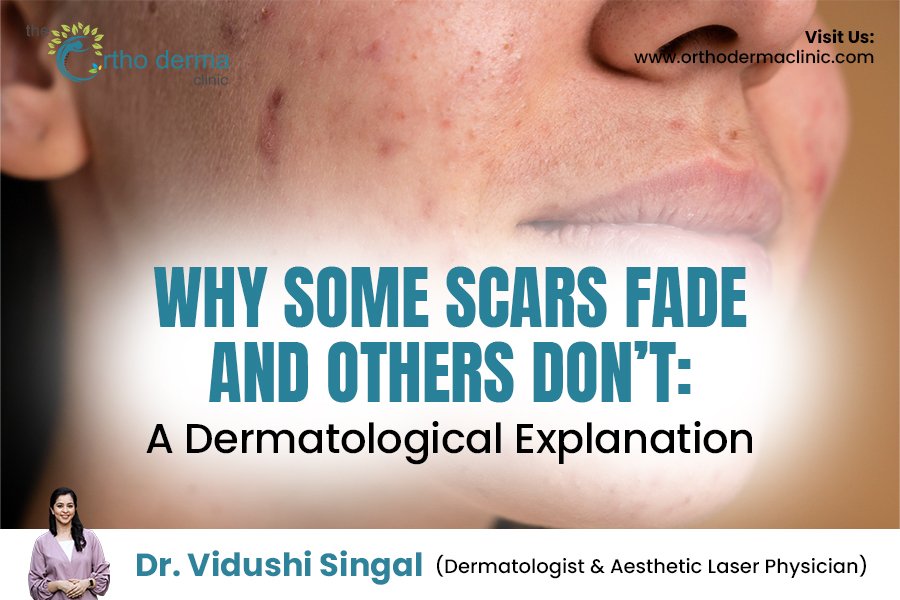
Scars are a natural part of the skin’s healing process. Whether caused by acne, injury, surgery, burns, or infections, most people assume that scars will gradually fade with time. While this is true in some cases, others remain visible for years — and sometimes permanently.
So why do some scars fade naturally while others don’t?
Understanding the science behind scar formation helps explain the difference — and more importantly, what can be done about it.
What Is a Scar?
A scar forms when the skin repairs itself after injury. During healing, the body produces collagen fibers to close the wound. However, the new tissue is not identical to normal skin.
Scar tissue:
- Has a different collagen arrangement
- May lack sweat glands and hair follicles
- Can appear raised, depressed, darker, or lighter than surrounding skin
The final appearance depends on several biological and external factors.
Why Do Some Scars Fade Naturally?
1. Superficial Skin Injury
When only the upper layers of the skin (epidermis) are affected, the body can regenerate tissue more effectively.
Examples:
- Mild acne marks
- Minor cuts
- Superficial burns
These often fade over time because the deeper dermal layer remains intact.
2. Balanced Collagen Production
Normal healing involves controlled collagen deposition. When collagen production is proportionate and well-organized, scars gradually flatten and blend into surrounding skin.
This is why some surgical scars become barely noticeable after several months.
3. Younger Skin and Good Healing Capacity
Younger individuals typically have:
- Faster cell turnover
- Better collagen remodeling
- Stronger repair mechanisms
This can contribute to better scar fading.
4. Proper Wound Care
Early wound management significantly impacts scar outcome.
Factors that improve healing:
- Keeping wounds clean
- Avoiding infection
- Protecting from sun exposure
- Avoiding picking or scratching
Sun protection is especially important because UV exposure can darken scars, making them more visible.
Why Do Some Scars Not Fade?
Not all scars behave the same way. Some remain visible due to deeper structural damage or abnormal healing responses.
1. Deep Dermal Damage
If an injury extends into the deeper dermis, collagen structure is significantly disrupted. The body replaces this tissue with thicker, fibrous scar tissue.
Examples:
- Deep acne cysts
- Surgical incisions
- Severe burns
- Trauma wounds
These scars are less likely to fade without treatment.
2. Abnormal Collagen Overproduction
Certain individuals produce excessive collagen during healing, leading to:
Hypertrophic Scars
- Raised but confined to the wound area
- May improve over time
Keloid Scars
- Raised and extend beyond original injury
- Often persistent
- May require medical intervention
Keloid scars are influenced by genetic predisposition and are more common in certain skin types.
3. Inflammatory Acne Scars
Severe inflammatory acne damages deeper skin layers, resulting in:
- Ice pick scars
- Boxcar scars
- Rolling scars
These are structural depressions caused by collagen loss. Since tissue volume is lost, they cannot simply “fade” — they require targeted acne scar treatment.
4. Skin Type and Pigmentation
Individuals with medium to darker skin tones are more prone to:
- Post-inflammatory hyperpigmentation (PIH)
- Dark spots after acne or injury
While pigmentation may fade gradually, repeated inflammation can make discoloration persistent.
5. Repeated Trauma to the Area
Picking acne, scratching wounds, or friction over healing skin can worsen scar formation.
Types of Scars and Their Behavior
Understanding scar type helps determine whether it will fade or need treatment.
Atrophic Scars (Depressed Scars)
- Common in acne
- Caused by collagen loss
- Rarely fade completely without procedures
Hypertrophic Scars
- Raised and thick
- May flatten with time
- Respond to medical treatments
Keloid Scars
- Grow beyond wound edges
- Persistent
- Require dermatologist-guided treatment
Pigmented Scars
- Dark marks after inflammation
- Often improve gradually with sun protection and treatment
Can You Make Stubborn Scars Fade?
Yes — modern dermatology offers effective scar removal treatments and scar reduction procedures tailored to scar type.
At Orthoderma Clinic, treatment plans are customized based on scar severity, type, and skin condition.
Advanced Scar Treatment Options
1. Laser Scar Treatment
Laser technology helps by:
- Stimulating collagen remodeling
- Reducing pigmentation
- Improving skin texture
This treatment is commonly used for acne scars and surgical scars.
2. Microneedling
Microneedling creates controlled micro-injuries that stimulate collagen production.
Effective for:
- Acne scars
- Textural irregularities
- Mild atrophic scars
3. RF Microneedling
Combines radiofrequency energy with microneedling for deeper collagen stimulation.
Suitable for:
- Moderate acne scars
- Skin tightening with scar improvement
4. Chemical Peels
Useful for:
- Pigmented scars
- Superficial acne marks
- Uneven skin tone
5. Subcision
A specialized procedure used for depressed scars where fibrous bands are released to lift the scar.
6. Steroid Injections
Commonly used for:
- Hypertrophic scars
- Keloid scars
These help flatten raised scars over time.
How Long Does Scar Treatment Take?
Scar improvement is gradual.
Depending on severity:
- 3–6 sessions may be required
- Combination therapies often give best results
- Maintenance treatments may be recommended
Realistic expectations are important — complete removal is not always possible, but significant improvement is achievable.
When Should You See a Dermatologist for Scar Treatment?
Consult a dermatologist if:
- The scar is raised, thick, or expanding
- The scar is deeply depressed
- You have persistent pigmentation
- Over-the-counter creams have not worked
- The scar affects confidence or comfort
Early intervention often produces better results.
Do Scar Creams Really Work?
Most over-the-counter scar creams:
- Help with mild pigmentation
- Provide hydration
- Support minor healing
However, they cannot correct:
- Deep acne scars
- Structural depressions
- Keloids
Medical treatments are often necessary for noticeable improvement.
The Bottom Line: Why Some Scars Fade and Others Don’t
Scars fade when:
- Damage is superficial
- Collagen remodeling is balanced
- Proper wound care is followed
Scars persist when:
- Injury is deep
- Collagen production is abnormal
- There is genetic predisposition
- Inflammation is severe
The key is identifying scar type and choosing the correct treatment approach.
Personalized Scar Treatment at Orthoderma Clinic
Every scar is different — and so is every treatment plan.
At Orthoderma Clinic, evaluation includes:
- Scar type assessment
- Skin type analysis
- Depth and severity evaluation
- Customized treatment combinations
The goal is not just to reduce visibility but to restore smoother, healthier-looking skin safely and effectively.
If you’re concerned about acne scars, surgical scars, or pigmentation marks, professional evaluation can help determine the best course of action.